The labour-cost gap remains substantial
Labour remains one of the clearest sources of cost variation between automotive production locations.
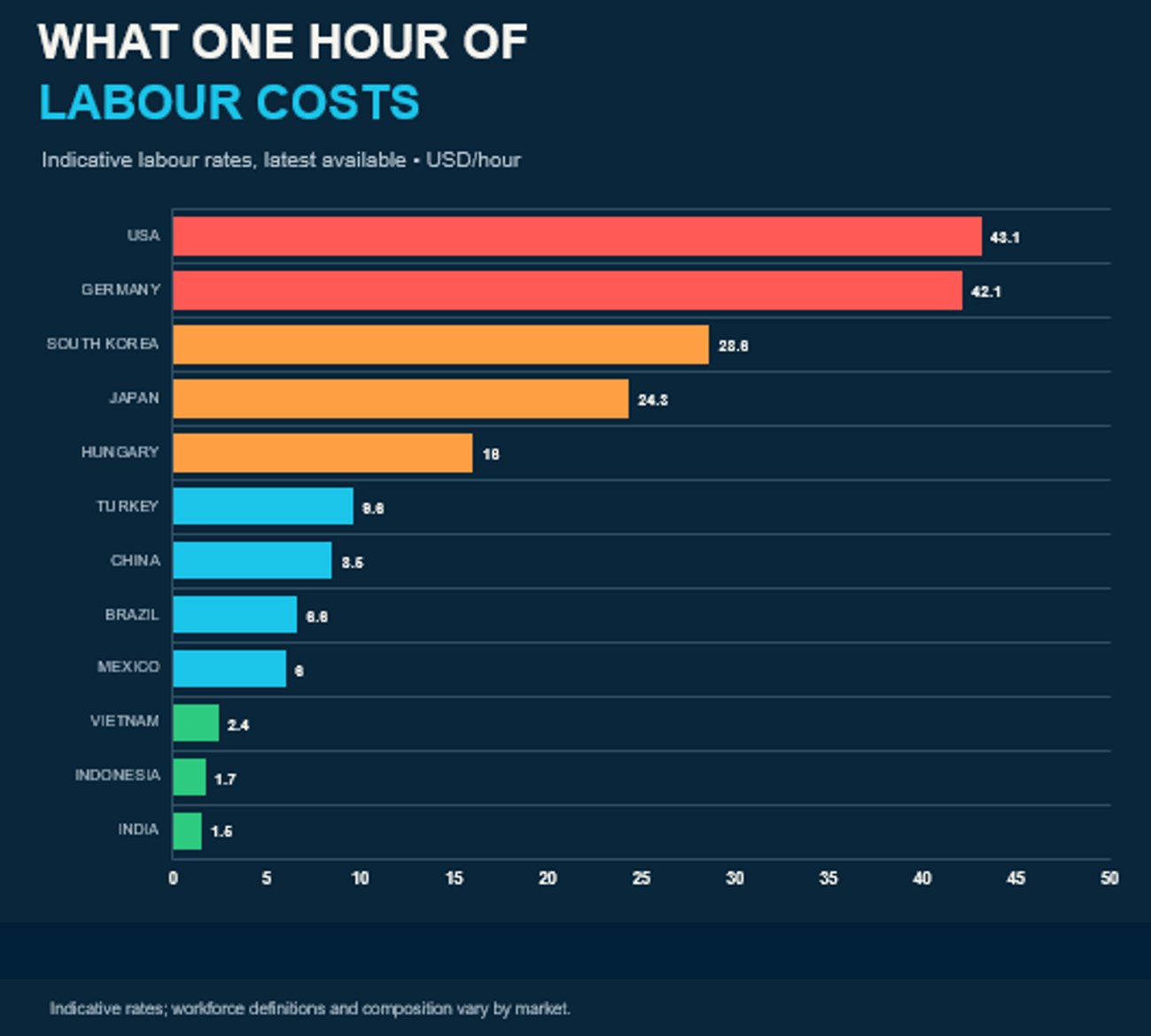
The difference between the highest- and lowest-cost countries is still large enough to influence plant location, sourcing strategy, product allocation and supplier competitiveness. Mature industrial markets such as the United States and Germany carry substantially higher employment costs than emerging manufacturing locations in South and Southeast Asia.
This does not mean that production will automatically migrate towards the country with the lowest wage rate. Labour represents only one component of total vehicle-production cost, and its importance differs according to the product, process and level of automation.
Nevertheless, even where labour accounts for a relatively modest share of total cost, a large country-to-country difference can materially affect the economics of labour-intensive components, assembly operations and supporting services.
Lower-cost markets are not standing still
The country ranking tells only part of the story.
India, Indonesia and Vietnam continue to offer significant labour-cost advantages. Their position supports the case for further automotive investment, particularly where manufacturers and suppliers can combine competitive employment costs with sufficient infrastructure, skills, scale and supply-chain availability.
However, low-cost does not mean static.
China’s labour costs have increased considerably over the longer term as manufacturing capability, employee incomes and living standards have developed. China remains highly competitive in many areas because labour cost is accompanied by scale, supplier density, infrastructure, productivity and increasingly sophisticated industrial capabilities. It should no longer be assessed simply as the lowest-wage alternative.
Turkey presents a different challenge. Nominal wage increases and high domestic inflation can create rapid changes in local-currency employment costs, while exchange-rate movements can offset or amplify the impact when costs are converted into euros or US dollars.
For budgeting purposes, this means a market can remain relatively inexpensive while simultaneously recording one of the fastest rates of cost growth.
Exchange rates can change the comparison
International labour-cost comparisons require a consistent reporting currency, but this introduces another source of movement.
A substantial local wage increase may appear moderate when translated into euros if the local currency depreciates. Conversely, an appreciating currency can increase the reported international cost even where domestic wage growth is relatively contained.
This creates two related but different exposures:
- the underlying increase in local employment cost;
- the translated cost viewed from the parent company or purchasing organisation.
The distinction is particularly important when comparing countries experiencing high inflation or exchange-rate volatility. A favourable currency movement may temporarily protect the reported cost, but it does not necessarily remove the underlying pressure on local wages and supplier prices.

A common-currency comparison is necessary for international decision-making, but the local-currency development provides an important indication of future cost pressure.
Headline wages are not the complete cost
A meaningful comparison should extend beyond the wage received directly by the employee.
Depending on the country, the employer may also bear costs associated with:
- social-security contributions;
- health or pension obligations;
- paid leave and statutory bonuses;
- shift, overtime and unsocial-hours premiums;
- recruitment and training;
- severance and employment protection;
- temporary labour or agency fees.
The relationship between gross wages and total employer cost differs considerably across markets. Comparing one country’s base wage with another country’s fully burdened employment cost can therefore produce a misleading result.
The appropriate measure for production-cost analysis is the labour cost actually incurred by the employer, applied consistently across all locations.
Productivity matters—but should not be used as a blanket adjustment
A higher hourly labour cost does not automatically mean a proportionately higher labour cost per vehicle.
Automation, plant utilisation, workforce experience, quality performance, absenteeism and production complexity all affect the number of labour hours required for a unit of output. A highly productive plant in a high-wage location may therefore remain competitive with a lower-wage operation requiring more labour hours, rework or supervision.
However, “productivity” should not become a general assumption used to dismiss measurable wage differences. It needs to be supported by plant- or process-specific evidence.
A robust comparison separates:
- Cost per labour hour
- Labour hours required per vehicle or component
- Resulting labour cost per unit
This makes it possible to identify whether a cost difference comes from wage levels, productivity, product complexity or a combination of the three.
What does this mean for sourcing and budgeting?
For established plants, the immediate question is often the rate at which labour costs are changing and whether this movement has been properly reflected in supplier negotiations and internal budgets.
For new sourcing or investment decisions, the questions are broader:
- Is the current labour-cost advantage likely to persist?
- How quickly are wages rising?
- Is the advantage dependent on a favourable exchange rate?
- Does the market offer the necessary skills and supplier infrastructure?
- How much automation is appropriate at the prevailing wage level?
- What additional logistics, energy, quality or inventory costs accompany the location?
A low labour rate can support competitiveness, but it cannot be evaluated independently of the complete production-cost structure.
The planning conclusion
The global labour-cost gap remains wide. That remains strategically important for the automotive industry.
But the direction of movement also matters. Some lower-cost markets are experiencing faster wage growth than mature locations, while inflation and currency changes can alter the international comparison within a relatively short period.
A budget based only on last year’s country ranking may therefore miss an important part of the picture. Manufacturers and suppliers need both the current cost level, and a consistent view of how each market is developing.
PULSE tracks labour costs across established and emerging automotive production countries, alongside materials, energy, batteries, logistics and other major cost drivers. This provides a common basis for comparing locations and assessing how changes in one cost category interact with the wider production-cost structure.
About the data
The PULSE labour-cost comparison uses published national and international employment-cost data, converted into a consistent reporting currency where required. The comparison is designed to support international cost analysis; definitions and reporting periods may vary between national sources and are reviewed as part of the PULSE methodology.
Currency movements can materially affect the reported comparison. Data shown are the latest available at the stated cut-off date and do not constitute an investment, employment or plant-location recommendation.