“Chip prices” are not moving together
It is tempting to discuss semiconductors as one market. In practice, an electronic system contains multiple component categories with different supply-and-demand dynamics.
These may include:
- DRAM and other working memory;
- NAND Flash and embedded storage;
- microcontrollers;
- processors and system-on-chip devices;
- analogue and power semiconductors;
- communications and connectivity chips;
- sensors;
- controllers and supporting electronic components.
Prices can rise strongly in one category while remaining stable—or even falling—in another.
Recent TrendForce data illustrate this divergence. In its second-half August contract-price tables, the average price change was:
- +4.17% for a DDR4 16Gb DRAM chip;
- +2.31% for a DDR5 8GB notebook memory module;
- +1.36% for a 64Gb MLC NAND Flash product.
By contrast, the 512Gb TLC NAND wafer spot benchmark recorded a 2.45% session decline on 28 September.
These changes cover different products, markets and measurement periods. They should not be placed on a single scale as though they represented directly comparable investment returns. What they demonstrate is that the memory market is not moving uniformly.
The Q4 outlook points to broader upward pressure
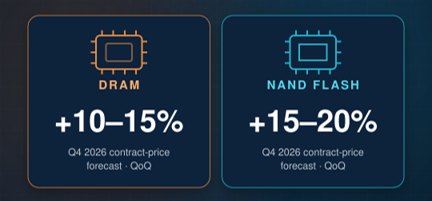
TrendForce’s latest forecast indicates a stronger overall pricing environment for memory in the final quarter of 2026.
Conventional DRAM contract prices are projected to rise by 10–15% quarter on quarter, while NAND Flash contract prices are expected to increase by 15–20%.
The common driver is not simply an increase in demand for all electronic devices. The market is being reshaped by the type of demand suppliers are choosing to serve.
AI servers require large volumes of high-performance memory and storage. This demand supports higher prices and margins, encouraging producers to allocate advanced-process capacity, investment and supporting resources towards server-related products.
That does not mean every memory product is in equally short supply. Consumer demand remains weaker in some applications, buyers may hold inventory, and individual products can experience different pricing conditions.
The result is a divided market: strong AI-related demand is lifting the overall pricing environment, while product-level movements remain uneven.
Capacity allocation matters beyond AI servers
Automotive manufacturers do not generally purchase the same memory products used in the most advanced AI-server systems. However, capacity decisions in one part of the semiconductor market can affect availability and pricing elsewhere.
Suppliers make choices about:
- which processes to prioritise;
- which products to continue manufacturing;
- where to allocate capital expenditure;
- which customers receive constrained capacity;
- whether to reduce output of older or lower-margin products.
As production and investment move towards more profitable server applications, availability can tighten in other categories—even where those products are not used directly in AI infrastructure.
This is particularly relevant where automotive systems depend on long-qualified components or mature product generations. Automotive buyers cannot necessarily substitute a different chip immediately because the replacement may require technical validation, software changes, safety approval or a revised system design.
Why vehicle electronics may be affected differently
Modern vehicles contain memory and storage across an expanding range of systems, including:
- infotainment and navigation;
- digital instrument clusters;
- connectivity and telematics;
- advanced driver-assistance systems;
- cameras and sensor-processing units;
- central and zonal controllers;
- gateways and over-the-air update systems.
However, the memory specification, supplier and commercial agreement differ between applications.
A rise in a general DDR4, DDR5 or NAND benchmark should therefore not be treated as an equivalent increase in every automotive component containing memory.
The eventual impact depends on:
Component architecture
How much DRAM or NAND is contained in the system?Automotive qualification
Does the component require extended temperature performance, long-term availability or safety-related validation?Contract structure
Is the price fixed, indexed, renegotiated periodically or purchased through the spot market?Inventory position
Does the supplier have lower-cost stock purchased before the latest increase?Supplier leverage
Can the Tier 1 supplier absorb the movement, or will it seek to recover the cost from the vehicle manufacturer?Redesign flexibility
Can another component be qualified without significant engineering cost or delay?
These factors determine whether a market-price increase appears quickly in the vehicle bill of materials, emerges at the next commercial negotiation or remains largely absorbed within the supply chain.
Memory is only part of the electronics bill
The total vehicle-electronics cost should not be inferred from memory-market movements alone.
An electronics cost breakdown may include memory, controllers, processors, sensors, power electronics, displays, printed circuit boards, passive components and complete electronic modules. The relative weight of these categories differs substantially according to the vehicle and its technical content.
A 15% increase in one memory category does not mean a 15% increase in the complete vehicle-electronics bill.
The appropriate calculation is:
Affected component share × relevant price movement × expected supplier pass-through
This separates an attention-grabbing semiconductor headline from the actual production-cost exposure.
What should purchasing and budgeting teams monitor?
A robust electronics-cost outlook should track three levels.
1. Market benchmarks
DRAM, NAND and other semiconductor benchmarks show the direction and intensity of market pressure.
2. Vehicle-component exposure
The memory and semiconductor content of the relevant modules must be identified to determine which benchmarks are commercially relevant.
3. Supplier pass-through
Contract timing, inventory, qualification restrictions and supplier negotiations determine how much market movement ultimately reaches the customer.
Scenario analysis can then distinguish between:
- temporary memory-price pressure;
- sustained supply tightening through 2027;
- limited automotive pass-through;
- broader electronics inflation caused by several semiconductor categories moving together.
The planning conclusion
AI demand is influencing the wider semiconductor supply chain, but “AI is making every chip more expensive” is too broad to support a vehicle-cost assumption.
The evidence points to rising overall pressure in DRAM and NAND, accompanied by significant differences between individual products and applications. Automotive-qualified components may follow a different timetable and pricing path from general consumer or server-market benchmarks.
For vehicle-cost planning, the useful question is therefore:
Which chips are driving the electronics bill—and how much of the market movement can actually reach the vehicle?
PULSE tracks electronics costs alongside raw materials, batteries, labour, energy and logistics. This provides a structured basis for identifying the relevant cost drivers and separating general market movement from vehicle-specific exposure.
About the data
Observed product-price movements are taken from TrendForce’s public DRAM and NAND Flash price tables. Contract-price and spot-market changes refer to different products and measurement periods and should not be interpreted as directly comparable returns.
The Q4 figures are TrendForce forecasts for conventional DRAM and overall NAND Flash contract prices. They are market outlooks rather than observed automotive-component price changes.
General memory benchmarks do not establish the same price movement for automotive-qualified parts or complete electronic modules.