When comparing cars, the visible costs tend to dominate: the purchase price, the monthly payment, the fuel bill and the insurance renewal.
Depreciation is easier to overlook. There is no regular invoice for the value a vehicle loses. For someone buying outright, the cost only becomes fully apparent when it is time to sell. For someone leasing, expected depreciation is already built into the monthly payment.
That makes resale value an important part of the ownership calculation—and makes the way we measure it worth questioning.
A smaller gap after adjustments
Electric vehicles have faced particular scrutiny over their resale values. But a September 2026 analysis by Transport & Environment (T&E) suggests that headline comparisons can overstate the difference between EVs and combustion cars.
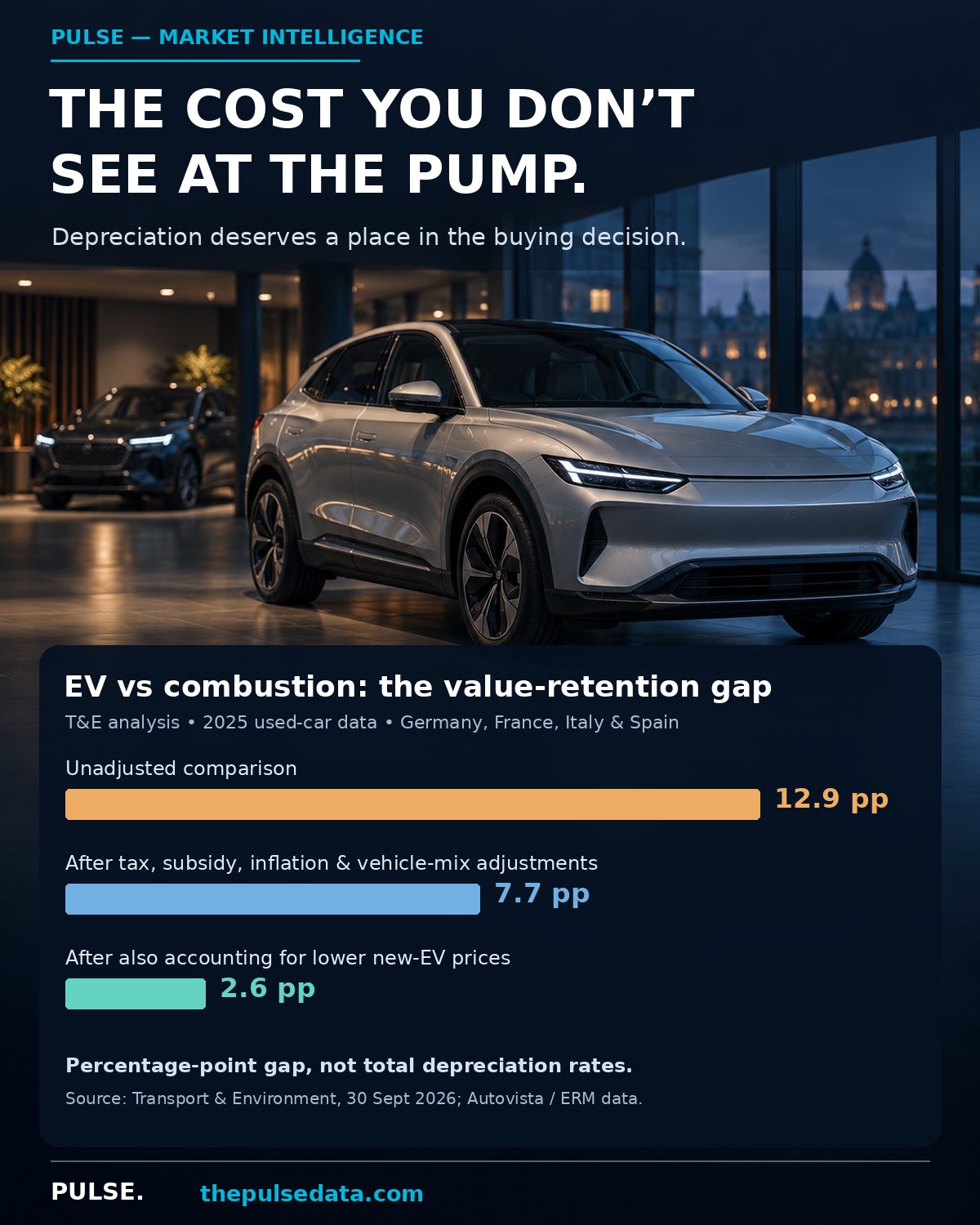
Using 2025 used-car data for Germany, France, Italy and Spain, the analysis identifies an unadjusted gap of 12.9 percentage points in value retention. Adjustments for purchase subsidies, acquisition taxes, inflation and differences in vehicle mix reduce that gap to 7.7 points. Accounting separately for the effect of lower new-EV prices brings it to 2.6 points—around 80% below the original comparison.
These are differences between the two groups, not their total depreciation rates. The finding does not mean that EVs lose only 2.6% of their value, or that every EV holds its value as well as an equivalent petrol car.
The starting price changes the answer
A depreciation percentage depends on the purchase price used as its starting point.
If a buyer receives a subsidy, measuring the subsequent loss against the full list price can make depreciation look worse than the loss on the money actually paid. Taxes, discounts and differences in the age and mileage of vehicles being compared also affect the result.
New-car pricing adds another complication. When a manufacturer cuts the price of a new EV, a used example competes against that cheaper alternative. Its resale value can fall even if its condition and usefulness remain unchanged.
For an existing owner, that is still a real financial loss. Adjusting for the effect helps explain the difference between powertrains; it does not put the lost money back in the owner’s pocket. Nor does the study guarantee that new-EV prices will stabilise.
What this means for buyers
The practical lesson is to compare the full ownership period, using the price actually paid and a realistic estimate of the eventual selling price.
For example, a €3,000 difference in resale value over four years is equivalent to €62.50 a month. That is an illustrative calculation, but it shows why residual-value assumptions deserve attention alongside fuel and maintenance savings.
The same principle applies to leasing. A lower assumed resale value increases the depreciation a contract must recover, all else equal. Monthly payments also include financing costs, fees and margins, so the T&E findings alone do not establish that any particular lease is overpriced.
Buyers should therefore compare specific models, ownership periods and financing terms. Battery condition, warranty cover, mileage and the price of competing new vehicles all deserve consideration.
Look beyond the purchase
For someone buying used, a lower resale price can mean a more affordable entry point. For the original owner, it can mean a larger ownership cost. The same market movement affects the two buyers differently.
The important question is not simply whether an EV or a combustion car depreciates faster on average. It is how much value the particular vehicle is likely to lose during the period you intend to own it.
Before deciding what a car costs, consider both ends of the transaction:
What you pay to buy it, and what you expect to recover when you sell it.
Sources
- Transport & Environment, “Second-hand EVs retain their value better than industry claims, study”, 30 September 2026. Analysis of 2025 data for Germany, France, Italy and Spain, drawing on Autovista data. Findings and adjustments are attributed to T&E.