China’s vehicle cost advantage is often discussed through wages, batteries and supplier prices. Factory utilisation and development speed deserve attention alongside those inputs.
For leading manufacturers, strong sales spread investment across more vehicles, while efficient development brings new products to market sooner. Together, these capabilities can strengthen competitiveness before the next purchasing negotiation begins.
But how much of the advantage comes from keeping factories busy? The evidence points to an important contribution, rather than a single explanation—or a reliable percentage that applies across the industry.
The utilisation gap is real—but it is not simply China versus the West
Rhodium Group estimates that Western automakers’ manufacturing capacity in China operates at around 42% utilisation, well below Chinese competitors. Its analysis also identifies scale, lower overheads and vertical integration as important sources of Chinese manufacturers’ cost advantage.[1]
The location matters. This is a comparison within China, where foreign-owned manufacturers also have access to local workers and suppliers. It suggests that producing in a competitive location does not, by itself, guarantee a competitive cost per vehicle.
As sales fall, a manufacturer can be left supporting factories and equipment designed for much higher output. Reducing production does not remove those costs at the same rate.
Conversely, higher utilisation helps a successful manufacturer spread its fixed factory costs across more saleable vehicles. The relevant measure is sustainable output supported by demand: building inventory to keep a line moving can create discounting and financing costs later.
Development speed adds a second advantage
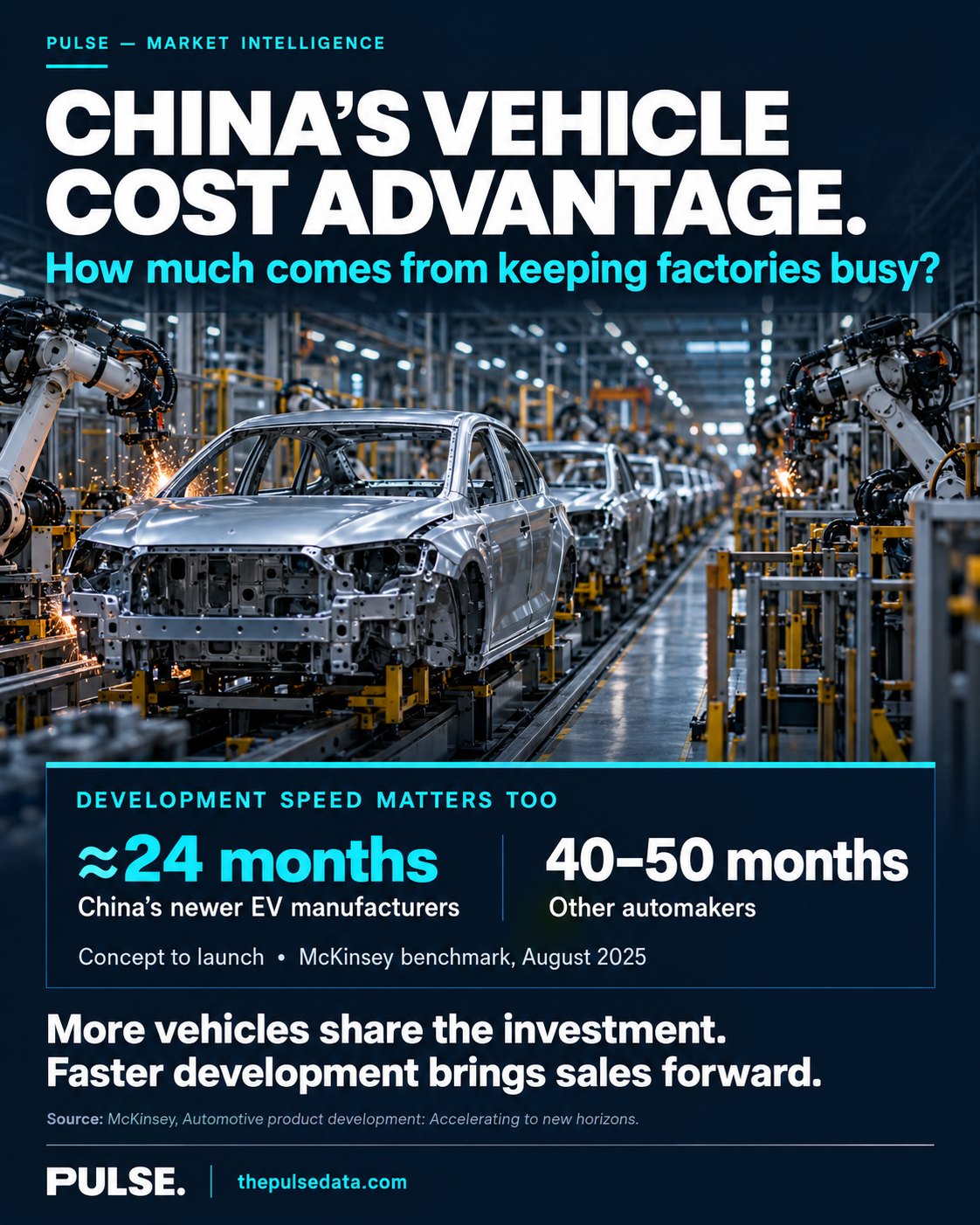
McKinsey’s August 2025 analysis benchmarks China’s newer EV manufacturers at roughly “24 months from concept to launch”, including platform development, compared with “40–50 months or longer” for other automakers.[2]
The practices behind that speed matter as much as the headline. McKinsey highlights component reuse, modular designs, virtual testing, earlier tooling decisions and closer supplier collaboration. These can reduce repeated work and make development resources more effective.
A shorter programme can also bring sales forward and reduce the risk that specifications are outdated by launch. However, halving the calendar does not automatically halve the development bill: the engineering effort, staffing and investment still need to be examined.
Volume and speed reinforce each other
Factory utilisation and development efficiency address different costs.
Utilisation spreads factory investment across output. Product and platform volumes spread engineering and tooling expenditure across the vehicles that use them. Component reuse can extend that benefit across several models.
Faster development can help manufacturers respond to demand while a market opportunity remains attractive. If those products sell, stronger volumes can then improve the economics of the production assets behind them.
That connection is important, but it is not automatic. A rapid launch with weak demand will not solve underutilisation. Nor does a busy factory establish that every model it builds earns an adequate return.
Faster replacement brings its own pressures
McKinsey also notes a trade-off: shorter vehicle lifecycles leave less time to recover tooling and setup costs. More frequent replacement increases the importance of component reuse and efficient production changeovers.[2]
Development time and market life are distinct. Developing a model quickly can be beneficial; replacing it quickly creates a separate investment-recovery question.
Manufacturers therefore need to manage speed alongside quality, warranty exposure and lifetime programme profitability.
What this means for European and North American OEMs
The implication is broader than increasing factory output. Manufacturers need capacity aligned with realistic demand, development programmes with manageable complexity, and platforms that support sufficient lifetime volumes.
Input-price competitiveness remains important. But cheaper materials cannot fully compensate for a production footprint or development budget spread across too few vehicles.
China also has underused factories, so this advantage should not be attributed uniformly to every Chinese manufacturer. It belongs to companies that successfully combine desirable products, disciplined investment and efficient execution.
For European and North American OEMs, the competitive question is therefore:
How effectively does each factory, platform and development programme turn investment into profitable sales?
Sources
- Rhodium Group, Why Are Chinese EVs So Cheap?, 19 February 2026. The 42% utilisation estimate relates to Western automakers’ capacity in China, not their global operations.
- McKinsey, Automotive product development: Accelerating to new horizons, 19 August 2025. Development benchmarks describe the groups analysed, not every manufacturer.